
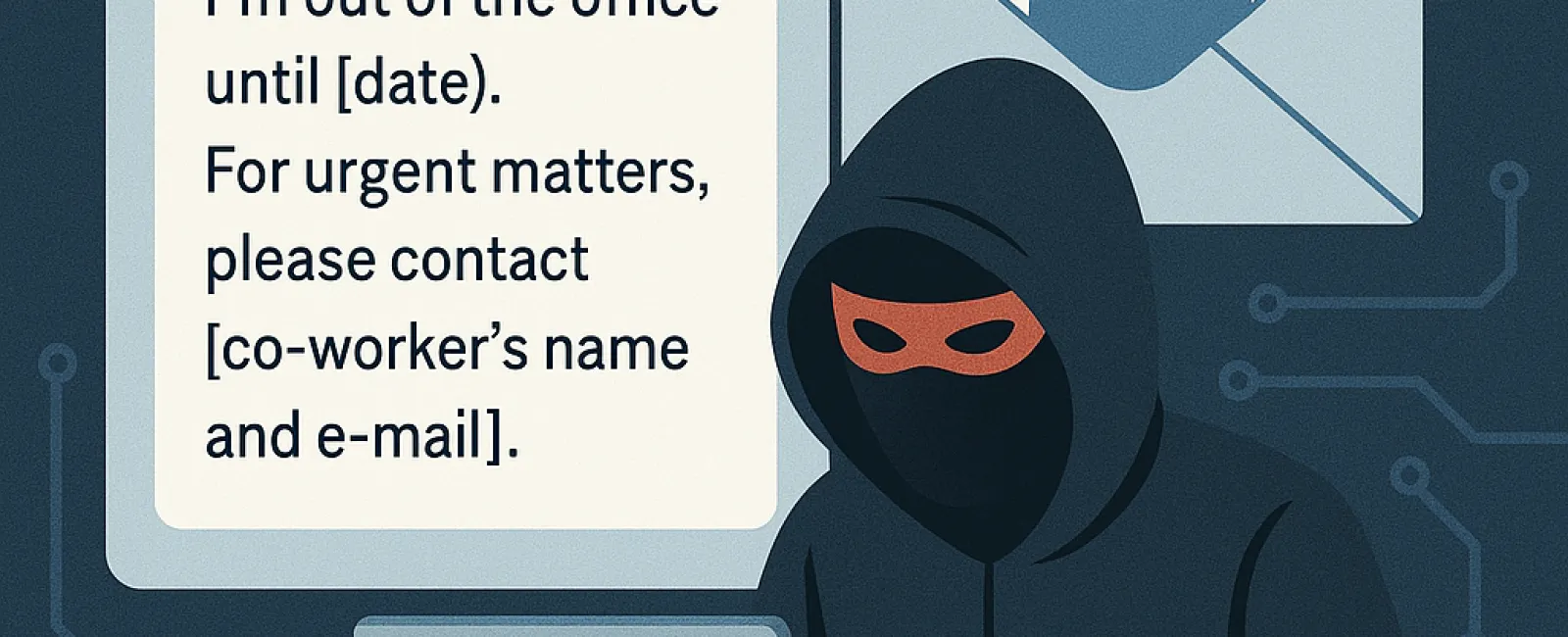
Set your out-of-office message and relax. But as you prepare for your trip, your inbox quietly announces to the world:
"Hello! I'm away until [date]. For urgent issues, please reach out to [coworker's name and e-mail]."
Seems helpful, right? Convenient even.
Yet, this is precisely the kind of information cybercriminals crave.
Your automatic reply, designed to keep communication seamless, actually hands over valuable intel to hackers seeking an easy entry point.
Consider what a typical out-of-office message reveals:
● Your full name and job title
● Dates when you’re unavailable
● Alternative contacts with their email addresses
● Insights into your team’s structure
● Even reasons for your absence (like "Attending a conference in Chicago…")
This information gives cybercriminals two critical advantages:
1. Perfect Timing: They know exactly when you’re away and less likely to spot suspicious activity.
2. Precise Targeting: They identify who to impersonate and who to deceive with scams.
This setup paves the way for devastating phishing and business email compromise (BEC) attacks.
How the Scam Unfolds
Step 1: Your auto-reply is triggered.
Step 2: A hacker exploits it to impersonate you or your listed alternate contact.
Step 3: They send a fraudulent urgent request for wire transfers, passwords, or sensitive documents.
Step 4: An unsuspecting coworker believes the request is legitimate.
Step 5: You return from vacation to discover funds have been wired to a fake vendor.
These scams are more common than you think and pose an even greater threat for businesses with traveling employees.
If your team frequently travels, especially executives or sales staff, and communication is handled by assistants or admins during absences, this creates ideal conditions for cyberattacks:
● Admins managing emails from multiple sources
● Handling payments, sensitive documents, or confidential requests
● Working quickly and trusting the identities they believe they’re communicating with
Just one sophisticated fake email can slip past defenses, leading to costly breaches or fraud.
Protecting Your Business Against Auto-Reply Exploits
Instead of abandoning out-of-office messages, use them smartly and implement strong protective measures. Here’s how:
1. Keep Your Message Ambiguous
Avoid revealing detailed schedules or naming backup contacts unless absolutely necessary.
Example: "I'm currently out of the office and will respond upon my return. For immediate assistance, please contact our main office at [main contact info]."
2. Educate Your Team
Ensure employees understand:
● Never act on urgent requests involving money or sensitive data based solely on email
● Always confirm unusual requests through a secondary channel, like a phone call
3. Deploy Advanced Email Security
Use sophisticated email filters, anti-spoofing technologies, and domain protection to block impersonation attempts.
4. Enforce Multi-Factor Authentication (MFA)
Enable MFA on all email accounts to prevent unauthorized access, even if passwords are compromised.
5. Partner with a Proactive IT Security Team
Work with cybersecurity experts who monitor login attempts, detect phishing, and identify abnormal activity before harm occurs.
Ready to Enjoy Your Vacation Without Cyber Risks?
We specialize in building robust cybersecurity defenses that protect your business—even when your team is out of the office.
Click Here or call us at 506-383-2895 to schedule your FREE 15-Minute Discovery Call.
We'll assess your systems for vulnerabilities and guide you on securing your operations so you can truly relax on your vacation without worrying about cyber threats.