January is the perfect time to tackle all those important tasks you've been delaying.
Doctor appointments. Dentist visits. Finally scheduling that mystery noise in your car to be checked.
While preventive care might seem dull, it's far less costly than an unexpected crisis.
Let's get real:
When was the last time your business technology underwent a thorough health check?
Not just fixing a broken printer last week — a comprehensive tech health evaluation.
Because there's a vast difference between systems that are merely functioning and those that are truly healthy.
Why the "I'm Fine" Mentality Can Be Dangerous
People often skip medical checkups because they feel fine.
Businesses fall into the same trap with their technology:
"Everything's running smoothly."
"We're too swamped right now."
"We'll fix it once a problem shows up."
Yet tech issues rarely give warning signs.
Just like high blood pressure quietly threatens health, unseen tech flaws silently weaken your infrastructure until they cause a crisis.
The typical causes for small business tech failures include:
- Ignored, well-known risks
- Obsolete equipment that seemed fine — until it failed
- Backups that exist in theory but fail in practice
- Unmonitored access permissions that accumulate over time
- Unnoticed compliance gaps that could trigger penalties
Your IT system might run day-to-day but could be just one unexpected event away from disaster.
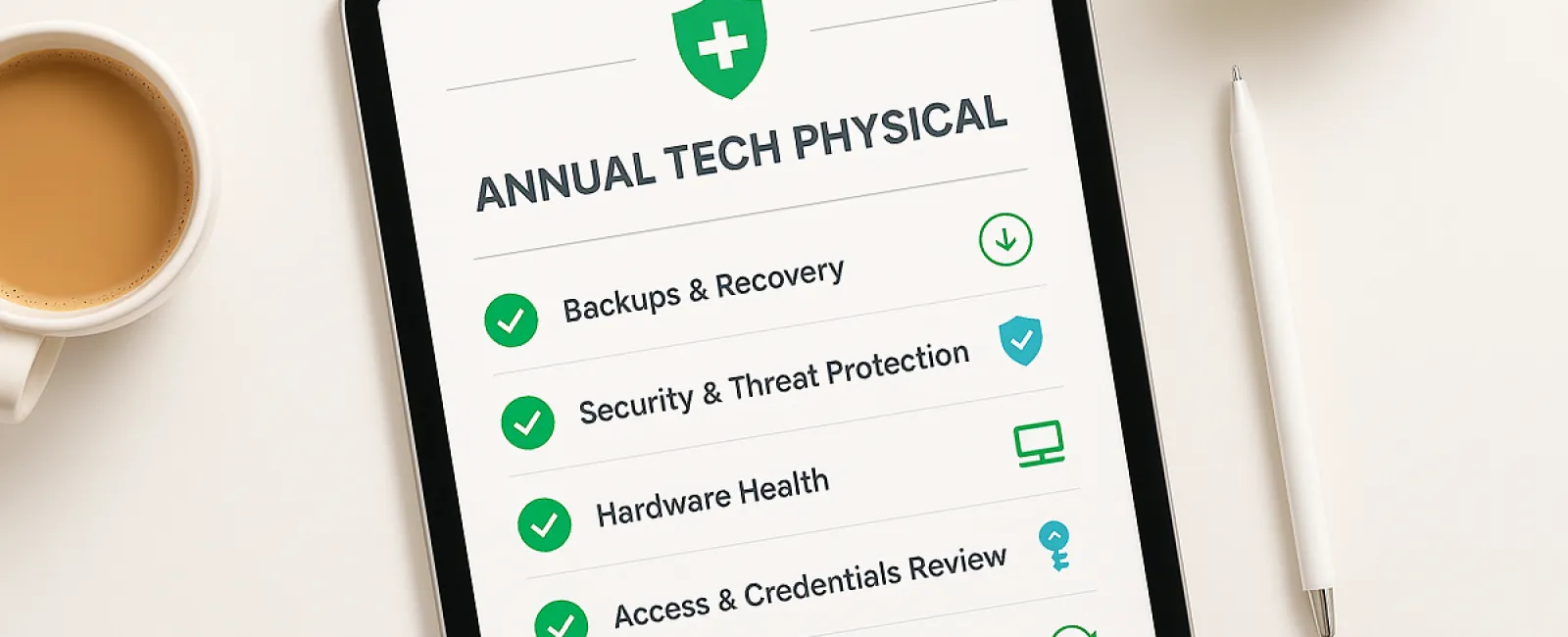
What a Comprehensive Tech Health Check Includes
A detailed technology assessment mirrors a doctor's examination: thorough, systematic, and designed to identify hidden issues before they escalate.
Core Check: Backup and Recovery Health
This is the lifeblood of your IT resilience. Can you recover quickly if everything else breaks down?
• Are backups completing successfully, not just scheduled?
• Have you recently performed a restore test? Actually recovered a file to confirm it works?
• If your server crashed at 9 a.m. on a Monday, how soon would your business be back online? Do you know?
Many companies only find their backup failures during an emergency—like discovering airbags don't deploy in a crash.
Critical Systems Review: Hardware and Infrastructure
Hardware doesn't fail overnight. It declines steadily—losing support, lagging performance, until it abruptly breaks at the worst time.
- How old is your essential equipment? Servers, firewalls, workstations?
- Are any devices beyond manufacturer support—meaning no security patches, updates, or technical assistance?
- Do you proactively replace hardware or wait until something completely fails?
Outdated hardware is a hidden culprit behind unexpected downtime. It slows operations and then suddenly stops.
Security Audit: Access and Credentials
Do you know exactly who has access to your systems? If your answer is uncertain, it's time for a review.
- Can you generate an up-to-date list of all user access?
- Are former employees or inactive vendors still active?
- Do you have shared accounts that obscure individual user activity?
Unchecked access accumulation, known as access creep, exposes small businesses to risk—not due to negligence—but simply because no one had time to manage it.
Emergency Preparedness: Disaster Readiness Assessment
Planning for worst-case scenarios isn't pleasant—but it's essential.
- Is there a concrete response plan if ransomware strikes tomorrow?
- Is this plan documented and regularly tested?
- How long could your business continue operating without your IT systems?
"We'll figure it out" isn't a plan—it's a gamble.
Industry Compliance: Meeting Your Unique Standards
Every industry has specific regulations defining "healthy" IT. Ignoring them leads to severe penalties.
- Healthcare providers must comply with HIPAA, where violations can cost $50,000 per incident.
- Businesses handling credit card payments face strict PCI compliance requirements; failure can block transaction processing.
- Client contracts increasingly demand stringent security measures, which must be followed.
You need tailored IT advice from experts familiar with your industry's demands—not just generic tips.
Signs It's Time for a Technology Checkup
If you recognize any of these thoughts, schedule your tech checkup immediately:
"I think our backups are working." (Are you sure?)
"Our server's old but still functional." (Until it suddenly fails—like a car breaking down unexpectedly.)
"We might have ex-employees still with access." (Possibly?)
"We have some sort of disaster plan... somewhere." (If you couldn't locate it in half a minute, it doesn't count.)
"If [name] leaves, things would fall apart." (Single points of failure always fail eventually.)
"We'd probably fail an audit, though we haven't been tested yet." (That day may come.)
Why Skipping Your Tech Checkup Can Cost You Dearly
A thorough checkup takes just a few hours.
Ignoring it can result in days, weeks, or even losing your entire business.
Here's the stark reality:
Data loss: Non-functional backups combined with server failure can erase all vital information—client data, finances, project files—sometimes beyond recovery.
Downtime: Every minute offline costs revenue, productivity, deadlines, and damages client trust.
Compliance penalties: HIPAA fines can reach $50,000 per violation; PCI noncompliance risks your ability to process payments; state privacy laws increasingly enforce penalties.
Ransomware attacks: For small businesses, average recovery costs exceed six figures, including ransom, remediation, lost business, and damaged reputation.
Investing in prevention might feel routine, but recovering from failure is costly and embarrassing.
Why Only a Specialist Can Deliver a True Tech Exam
You don't monitor your own blood pressure and declare perfect health—you rely on professionals with the skills and experience to interpret the results correctly.
Technology demands the same expertise.
You need a partner who:
- Understands the specific technology health standards for businesses like yours and your industry—not just generic best practices.
- Recognizes common patterns of failure and early warning signs based on extensive experience.
- Can spot issues you've gotten used to ignoring because they see your systems with fresh, outsider eyes.
That's true fire prevention—not waiting to fight a blaze.
Book Your Comprehensive Tech Checkup Today
It's January—time to schedule all your preventive care, including your business technology health.
Arrange your Annual Technology Physical.
We'll evaluate your IT environment and provide a clear, jargon-free report detailing what's secure, what's at risk, and which actions you should take before emergencies strike.
No pressure. Just straightforward insight.
Click here or give us a call at 506-383-2895 to book your 15-Minute Discovery Call.
The best time to prevent a problem is before it becomes an emergency.
That time is now.